
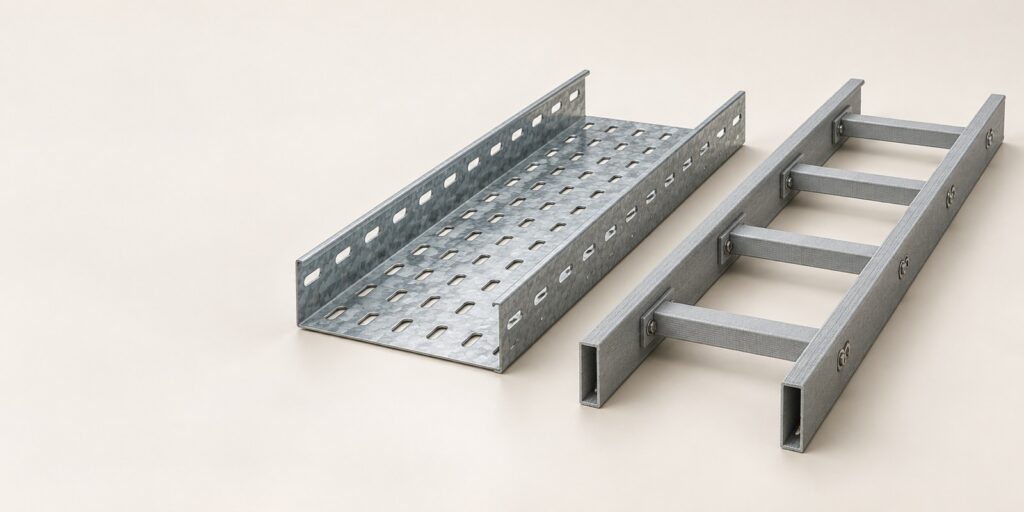
The material name is only the beginning of a cable tray specification. A useful comparison identifies the installation environment, cable loading, supports and documents required for the proposed route. For projects in Dubai, Abu Dhabi and across the UAE, these details help procurement teams compare offers on the same basis.
Define the environment before comparing materials
Separate indoor service areas from exposed outdoor routes. Record moisture, salt exposure, chemicals, wash-down conditions and the operating temperature where relevant. Include any unusual conditions around process equipment. A general description such as “industrial use” leaves too much open to interpretation.
For composites, ask which resin system is offered and whether its supporting data addresses the actual exposure. Chemical suitability depends on the substance, concentration, temperature and duration of exposure. Manufacturer corrosion guidance, such as Eaton’s fiberglass technical guide, illustrates why a single corrosion-resistance claim cannot cover every service condition. Its product ratings are specific to that manufacturer.
Compare complete systems
For a steel cable tray, identify the material grade, profile and protective finish. Where hot-dip galvanising is specified, confirm the coating requirement and how site cuts or drilled holes will be treated.
For a GRP/FRP cable tray, confirm the composite construction, route fittings, joint details and compatible supports. GRP describes glass-reinforced polymer; it is a type of the broader FRP material family. The terminology alone does not identify the offered resin or performance.
Put load and support spacing on the same schedule
Give each supplier the same cable loading, proposed support spacing and route geometry. Request load/span information for the exact tray size and configuration being offered. Also coordinate the brackets, channels, fixings and substrate: the tray is only one part of the supporting assembly.
A wider tray or heavier-looking section does not establish its allowable working load. Review the relevant product data, the basis of the tests and any temperature or installation limitations with the project’s technical team. Keep future cable allowance visible in the design requirement.
Request evidence that matches the requirement
Ask for the fire, electrical, material and structural documentation called for by the project specification. A brochure statement about one test must not be treated as evidence for another characteristic. Confirm that reports identify the offered product and configuration.
IEC 61537:2023 addresses requirements and tests for cable tray and cable ladder systems. Referencing its scope helps frame a document request; it does not establish that any particular Bonn Metals product is certified or compliant.
Questions buyers often ask
Does choosing GRP remove the need for technical review?
No. The composite system still needs a confirmed construction, load/span basis, exposure assessment and applicable project documents. Review these together before procurement.
Can I enquire before the material is final?
Yes. State that material selection is open and describe the environment and intended cable route. Keep alternative offers separately identified so differences remain clear.
Prepare a comparable enquiry
Send the tray type, dimensions if known, quantity, material preference, cable loading, support spacing and project location. Identify which items are fixed by the specification and which need discussion. Request a Bonn Metals quotation or use the product range and enquiry guide to organize the requirement.